

Understanding Indian Tea: From Green Tea and Oolong to Pekoe, TGFOP and CTC
India’s tea industry offers an extraordinary variety of teas. But for an international buyer, the terminology can sometimes be confusing.
What is the difference between black tea, green tea, white tea and oolong?
What does Pekoe, Orange Pekoe or TGFOP mean?
What is CTC tea?
And how do Darjeeling, Assam, Nilgiri and Uttarakhand teas differ?
Understanding these terms is essential when selecting tea for wholesale, retail, hospitality, food service or international distribution.
1. Black Tea – India’s Most Recognised Tea Category
Black tea is fully oxidised during processing. Oxidation develops the darker colour, deeper aroma and characteristic body associated with black tea.
India is particularly well known for black teas from:
Darjeeling
Assam
Nilgiri
Dooars and Terai
Kangra
Uttarakhand
Sikkim
South India
Taste Profile
Depending on origin and processing, Indian black tea can range from:
Light and floral → brisk and aromatic → fruity and muscatel → rich and malty → strong and full-bodied.
Darjeeling is generally appreciated for elegance and aromatic complexity, while Assam is known for its stronger, fuller and malty character.
Black tea is also the foundation of much of India’s traditional chai culture.
2. Green Tea – Fresh, Light and Naturally Vibrant
Green tea is produced with much less oxidation than black tea. The processing is designed to preserve the tea’s fresh character and naturally occurring compounds.
Indian green teas can be produced in regions including Darjeeling, Assam, Kangra, Nilgiri and other tea-growing areas.
Taste Profile
Depending on origin and processing, green tea may have:
Fresh vegetal notes
Floral aromas
Grassy character
Mild sweetness
Astringency
Light body
Clean finish
Green tea is particularly popular among consumers seeking a lighter alternative to traditional black tea.
Why Is Green Tea Considered Healthy?
Tea naturally contains polyphenols and other bioactive compounds. Green tea is particularly rich in catechins, including EGCG. Research has investigated tea consumption in relation to cardiovascular and metabolic health, although evidence varies and tea should not be presented as a treatment for disease. (Tea And Hope)
3. White Tea – The Delicate Side of Indian Tea
White tea is among the least processed traditional tea styles.
It is generally made from young buds and/or leaves that undergo minimal processing and oxidation.
The objective is to preserve the delicate character of the young tea material.
Taste Profile
Premium white tea may offer:
Delicate floral aromas
Subtle sweetness
Honey-like notes
Light body
Freshness
A clean, lingering finish
Because of its delicate character, white tea is often enjoyed without milk or strong flavouring.
India’s Himalayan and Darjeeling regions can produce speciality white teas that appeal to premium and speciality-tea buyers.
4. Oolong Tea – Between Green and Black Tea
Oolong occupies an interesting position between green and black tea.
Unlike green tea, oolong is partially oxidised. Unlike black tea, it is not fully oxidised.
This allows producers to create an enormous range of flavour profiles.
Oolong Can Be:
Light and floral
Fruity
Creamy
Toasty
Nutty
Rich and roasted
The level of oxidation and processing has a major influence on the final character.
For buyers seeking something different from conventional black and green tea, Indian speciality oolong can offer an interesting premium segment.
5. Orthodox Tea – Traditional Leaf Processing
Orthodox tea refers to traditional methods of processing tea leaves, generally preserving larger leaf structures rather than mechanically reducing them into the granular form associated with CTC.
Orthodox teas can include whole-leaf and broken-leaf grades.
They are particularly important in premium tea markets where buyers value:
Leaf appearance
Aroma
Complexity
Origin character
Slow and layered infusion
Darjeeling and premium Assam teas are particularly well known in the orthodox category.
6. CTC Tea – India’s Strong Chai Tea
CTC stands for:
Crush – Tear – Curl
Instead of preserving large leaf structures, the tea is mechanically processed into small, uniform particles.
This creates a tea that generally infuses quickly and produces strong colour and body.
CTC tea is particularly important in India’s domestic chai culture and is widely used in blends where tea is prepared with milk and sugar.
CTC Tea Is Ideal For:
Masala chai
Milk tea
Tea bags
Food-service applications
Commercial blends
Strong breakfast tea
Assam is particularly important for CTC production.
7. What Is Pekoe?
The word Pekoe can be confusing because it is not simply the name of a separate tea variety.
In the traditional tea trade, Pekoe-related terms are used as leaf grades.
They describe characteristics such as leaf size, appearance and the presence of young tips rather than simply telling you how the tea will taste.
This distinction is important for international buyers.
Pekoe does not mean a particular flavour.
8. Orange Pekoe – One of the Most Misunderstood Tea Terms
Orange Pekoe (OP) is a traditional black-tea leaf grade.
Despite its name, it does not mean orange-flavoured tea.
It is associated with a particular style and size of processed leaf.
A good way to understand the terminology is:
Tea type: Black tea
Leaf grade: Orange Pekoe
Therefore, Orange Pekoe is not a separate plant or flavour.
The same grade can taste different depending on whether it comes from Assam, Darjeeling, South India or another tea-growing region.
9. FOP – Flowery Orange Pekoe
FOP stands for Flowery Orange Pekoe.
The term indicates a whole-leaf style containing young tips.
The presence of tips can contribute to appearance and aroma, although the grade itself should not be treated as a guarantee of cup quality. (TeaSource)
FOP teas can be particularly interesting for buyers looking for orthodox whole-leaf Indian teas.
10. GFOP – Golden Flowery Orange Pekoe
GFOP stands for Golden Flowery Orange Pekoe.
The “Golden” reference relates to golden-coloured young tips present in the tea.
These golden tips are visually distinctive and can be associated with premium orthodox teas.
GFOP is encountered in Indian tea grading, including Assam and other orthodox-producing regions.
11. TGFOP – Tippy Golden Flowery Orange Pekoe
This is one of the better-known premium-sounding grades in the international tea trade.
TGFOP = Tippy Golden Flowery Orange Pekoe.
The “Tippy” designation indicates a higher presence of young tips.
The grade is particularly associated with premium orthodox teas from regions such as Darjeeling and Assam. (Wikipedia)
However, an important point for buyers is:
Grade ≠ guaranteed taste
A TGFOP designation describes the physical characteristics of the processed leaf. It does not by itself guarantee that one tea will taste better than another.
Origin, garden, cultivar, season, processing and storage all influence the final cup.
12. FTGFOP – Finest Tippy Golden Flowery Orange Pekoe
FTGFOP stands for:
Finest Tippy Golden Flowery Orange Pekoe.
It is used for orthodox teas with a high proportion of tips and carefully processed leaf.
This terminology is particularly encountered in premium Indian and other South Asian teas.
Some teas may carry a further designation such as:
FTGFOP1
The numerical suffix is part of particular grading conventions and should be interpreted according to the producer or market specification rather than assumed to be a universal quality score.
13. SFTGFOP – Special Finest Tippy Golden Flowery Orange Pekoe
At the top end of the traditional terminology is:
SFTGFOP – Special Finest Tippy Golden Flowery Orange Pekoe.
This designation is generally associated with highly selective orthodox leaf teas containing a significant proportion of young tips.
Premium Darjeeling teas may carry elaborate orthodox grades of this type.
For a buyer, however, the most important consideration remains the actual tea specification, origin, harvest, sensory profile and quality documentation—not the letters alone.
14. BOP – Broken Orange Pekoe
BOP stands for Broken Orange Pekoe.
Instead of remaining as a large whole leaf, the tea is broken into smaller particles.
Because smaller particles generally infuse faster, BOP can produce a stronger and quicker cup than a comparable whole-leaf tea.
It can therefore be useful for:
Breakfast teas
Blends
Tea bags
Strong black tea
Food service
BOP is particularly relevant in Assam and South Indian tea production. (Wikipedia)
15. FBOP – Flowery Broken Orange Pekoe
FBOP = Flowery Broken Orange Pekoe.
This is a broken-leaf grade that also contains young tips.
It combines faster infusion with the visual and aromatic characteristics associated with tips.
For buyers, it can provide an interesting balance between strength and aroma.
16. Fannings
Fannings are small tea-leaf particles produced during processing and grading.
Because of their smaller size, they generally infuse quickly and can produce strong colour.
Fannings are commonly used in tea bags and commercial blends.
They are not necessarily “bad tea”; their smaller particle size simply makes them suitable for a different brewing application.
17. Tea Dust
Dust represents very small tea particles.
Because of their small particle size, dust grades can infuse extremely quickly and produce strong colour and liquor.
They are widely used in commercial tea bags and strong chai applications.
For premium loose-leaf tea, however, buyers generally seek larger and more visually distinctive leaf grades.
18. Golden Tips and Silver Tips
Tea buds can be particularly valuable in speciality tea production.
Golden Tips
Golden tips are young buds that develop a characteristic golden appearance during processing.
They can contribute to the appearance, aroma and perceived delicacy of premium teas.
Silver Tips
Silver tips are young, unopened buds covered with fine hairs that can give them a silvery appearance.
They are particularly associated with speciality white teas.
These teas can command premium positioning because of their careful harvesting and processing.
19. Masala Chai – India’s Global Tea Culture
No discussion of Indian tea is complete without Masala Chai.
Masala chai is not a tea leaf variety. It is a preparation in which black tea is brewed with ingredients such as:
Ginger
Cardamom
Cinnamon
Cloves
Black pepper
Milk
Sugar
The exact recipe varies widely across India.
Assam CTC is commonly suited to this style because its strong liquor can stand up to milk, sugar and spices.
This is also one reason Assam tea has become such an important component of the global chai market.
A Simple Guide to Indian Tea Types:
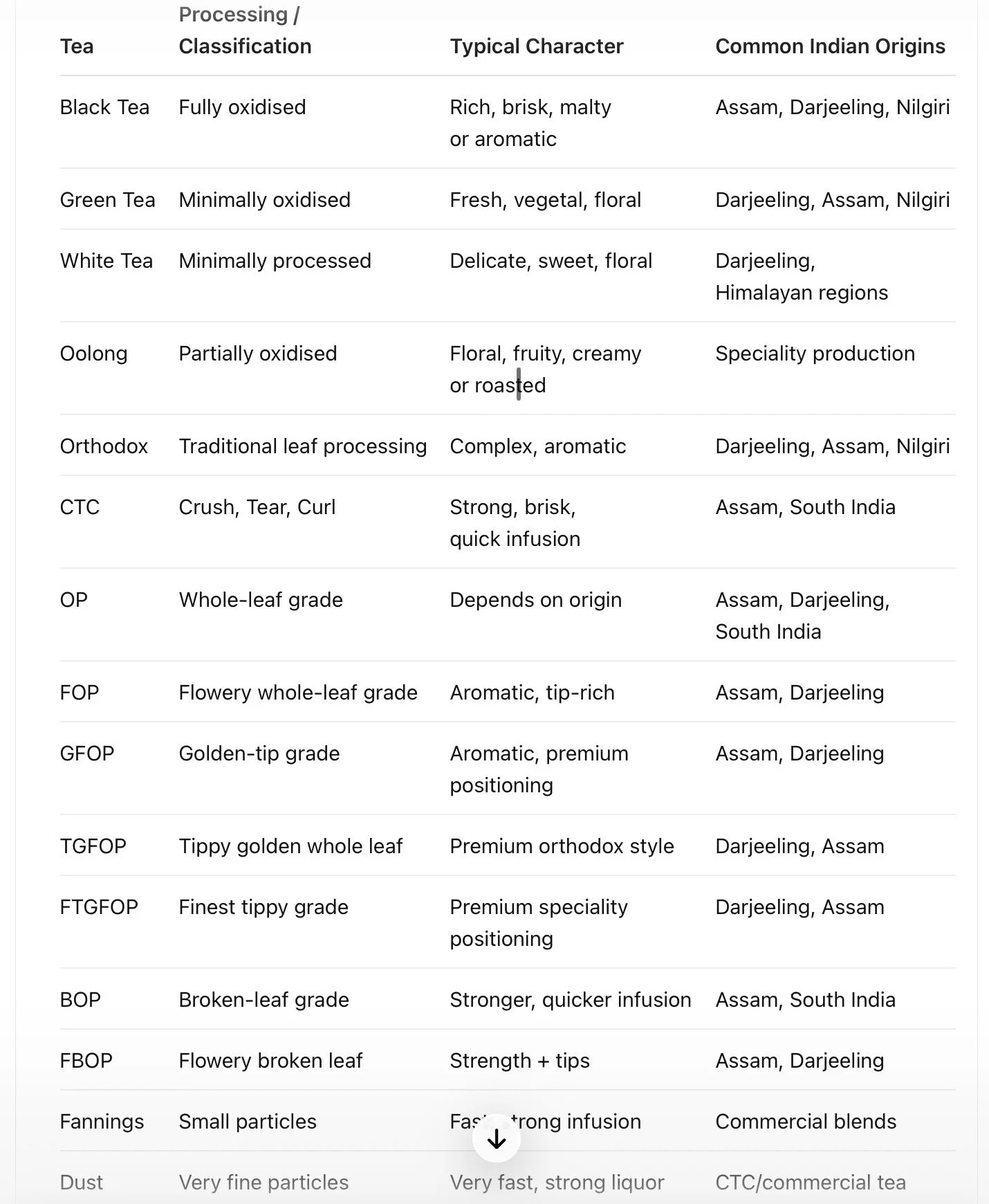
The grades above describe different physical or processing characteristics; they should not be interpreted as a universal ranking of taste or quality
The Great Indian Tea Regions
Darjeeling – Elegance and Muscatel Complexity
Darjeeling tea comes from the Himalayan foothills of West Bengal and is recognised for its distinctive aromatic character.
Premium Darjeeling can display:
Floral → fruity → muscatel → brisk → delicate
The First Flush is generally lighter and more aromatic, while Second Flush teas are particularly associated with the region’s celebrated muscatel character.
Authentic Darjeeling tea has GI protection and is associated with registered gardens and Tea Board requirements.
Assam – Strength and Maltiness
Assam’s lowland tea-growing environment produces a dramatically different style.
Premium Assam can deliver:
Malty → rich → full-bodied → brisk → deep amber
Orthodox Assam is particularly attractive to speciality buyers, while CTC Assam is widely used for strong chai.
Uttarakhand – Himalayan Tea
Uttarakhand provides another expression of India’s Himalayan tea potential.
Its smaller tea-growing regions can offer distinctive teas for buyers interested in origin-focused and speciality products.
The Himalayan environment gives these teas a different identity from the major commercial tea-producing regions of Assam and South India.
Nilgiri – Fragrant and Bright
The Nilgiri Hills of South India produce teas known for fragrance, brightness and briskness.
Nilgiri teas can be:
Floral → fruity → fresh → bright → clean
They are also valuable for blending because their aromatic profile can complement other teas.
Why This Diversity Matters to Global Buyers
For a tea importer, distributor or brand, India’s diversity creates the possibility of building an entire tea portfolio from one country.
A buyer could source:
Premium Darjeeling for speciality retail
Assam Orthodox for premium black-tea consumers
Assam CTC for chai and food service
Nilgiri for aromatic blends
Indian Green Tea for health-conscious consumers
White Tea for premium speciality markets
Oolong for contemporary tea consumers
Pekoe and other orthodox grades for loose-leaf tea products
This is where India’s strength as a global tea supplier becomes particularly compelling.
Anantaa Aahaar: Your Gateway to Indian Tea
At Anantaa Aahaar, we believe that global tea buyers should not have to navigate India’s enormous tea landscape alone.
Our objective is to help international buyers identify and procure teas according to their specific requirements—including:
Origin
Tea type
Leaf grade
Orthodox or CTC processing
Flush/harvest
Aroma and flavour profile
Packaging
Quantity
Market requirements
Export specifications
Whether your requirement is premium Darjeeling First Flush, Darjeeling Second Flush, Assam Orthodox, Assam CTC, Nilgiri tea, Indian Green Tea, White Tea, Oolong or speciality Pekoe grades, Anantaa Aahaar can help facilitate sourcing from India’s diverse tea-producing regions.
Our Philosophy
We don’t believe there is one “best” Indian tea.
There is the right Indian tea for the right market, consumer and application.
A speciality tea boutique may want a delicate Darjeeling.
A supermarket may require a consistent Assam blend.
A chai brand may prefer Assam CTC.
A premium wellness-focused brand may be interested in green or white tea.
A contemporary tea brand may want an Indian oolong.
Our role is to understand the requirement and connect it with the appropriate Indian tea supply.
From India’s Tea Gardens to the World
Indian tea represents centuries of agricultural knowledge, diverse landscapes and skilled processing.
From the delicate First Flush Darjeeling to robust Assam CTC, from aromatic Nilgiri to Himalayan teas, and from Green Tea and White Tea to Oolong and premium Orthodox grades, India’s tea industry offers a remarkable spectrum of products.
For global buyers, this means choice.
For Anantaa Aahaar, it means an opportunity to build bridges between India’s tea-growing communities and international markets.
Anantaa Aahaar
From India’s Finest Lands to Your Table.
For premium Indian tea sourcing and export enquiries, connect with Anantaa Aahaar to discuss your required origin, tea type, grade, quantity and packaging specification.
