

The Ultimate Guide to India’s Finest Premium Rice Varieties Comparison : 1121 vs 1718 vs 1509 vs 1886 Basmati Rice
Introduction
India is globally recognized as the birthplace of authentic Basmati rice, producing over 70% of the world’s Basmati exports. Renowned for its naturally long grains, captivating aroma, exceptional elongation after cooking, and delicate texture, Indian Basmati rice has become the preferred choice for households, luxury hotels, restaurants, wholesalers, and food distributors across the Middle East, Europe, North America, Africa, and Asia.
With the growing demand for premium-quality rice, several improved Basmati varieties have been developed to meet the evolving needs of farmers, exporters, millers, and international buyers. Among these, 1121 Basmati, 1718 Basmati, 1509 Basmati, and 1886 Basmati have emerged as the leading varieties due to their superior grain quality, excellent cooking performance, and strong export potential.
Each variety possesses distinct characteristics. While some are renowned for their exceptional grain elongation and aroma, others are valued for higher yields, shorter crop duration, or improved resistance to environmental stresses. Understanding these differences is essential for making informed purchasing, cultivation, and export decisions.
This comprehensive guide explores the unique qualities of each variety and compares them across grain quality, agronomic performance, cooking characteristics, milling recovery, export demand, and commercial suitability.
What Makes Basmati Rice Unique?
The word “Basmati” is derived from the Sanskrit words Vas (aroma) and Mati (full of), meaning “the fragrant one.” Unlike ordinary long-grain rice, authentic Basmati is distinguished by its naturally aromatic fragrance, extra-long slender grains, remarkable elongation after cooking, and light, fluffy texture.
Several characteristics define premium-quality Basmati rice:
Extra-long slender grains
Rich natural aroma
Exceptional grain elongation after cooking
Soft yet non-sticky texture
High milling recovery
Superior head rice yield
Excellent shelf life after ageing
Outstanding cooking performance
These qualities have established Indian Basmati rice as one of the world’s most premium agricultural exports.
History of Basmati Rice
The history of Basmati rice stretches back several centuries to the fertile foothills of the Himalayas, where unique climatic conditions, mineral-rich soils, and abundant river systems created the perfect environment for cultivating aromatic rice.
Traditional Basmati was grown across regions that today include parts of northern India and Pakistan. Historical references to aromatic long-grain rice appear in ancient literature and medieval writings, reflecting its long-standing reputation as a premium food reserved for royalty and ceremonial occasions.
Over time, scientific breeding programs in India led to the development of improved Basmati varieties that retained the cherished aroma and cooking qualities while delivering better yields, enhanced disease resistance, and greater adaptability to modern farming practices. Today, varieties such as 1121, 1718, 1509, and 1886 represent the evolution of this heritage, combining centuries of tradition with advanced agricultural research.
India’s Leadership in the Global Basmati Market
India is the world’s largest producer and exporter of Basmati rice. Every year, millions of tonnes are exported to more than 150 countries, serving diverse consumer preferences and culinary traditions.
Major importing regions include:
Middle East (Saudi Arabia, UAE, Kuwait, Qatar, Oman, Bahrain)
Europe (United Kingdom, Germany, Netherlands, France, Italy)
North America (United States and Canada)
Asia-Pacific (Singapore, Malaysia, Australia)
Africa (South Africa and East African nations)
Indian exporters are recognized for maintaining stringent quality standards, advanced milling infrastructure, and reliable supply chains. As global demand for premium rice continues to grow, Indian Basmati remains the benchmark for quality and authenticity.
Why Different Basmati Varieties Matter
Not all Basmati rice is the same. Different varieties have been developed to address specific agricultural and commercial needs.
For example:
1121 Basmati is celebrated for its extraordinary grain elongation and premium aroma.
1718 Basmati offers similar quality while providing improved field performance and greater stability.
1509 Basmati is prized for its early maturity, high productivity, and excellent farmer profitability.
1886 Basmati represents the next generation of premium Basmati with exceptional appearance, cooking quality, and increasing global demand.
Selecting the right variety depends on the intended application. Farmers prioritize yield and crop duration, exporters focus on international demand and grain quality, millers consider processing efficiency, while hotels and restaurants value cooking performance and presentation.
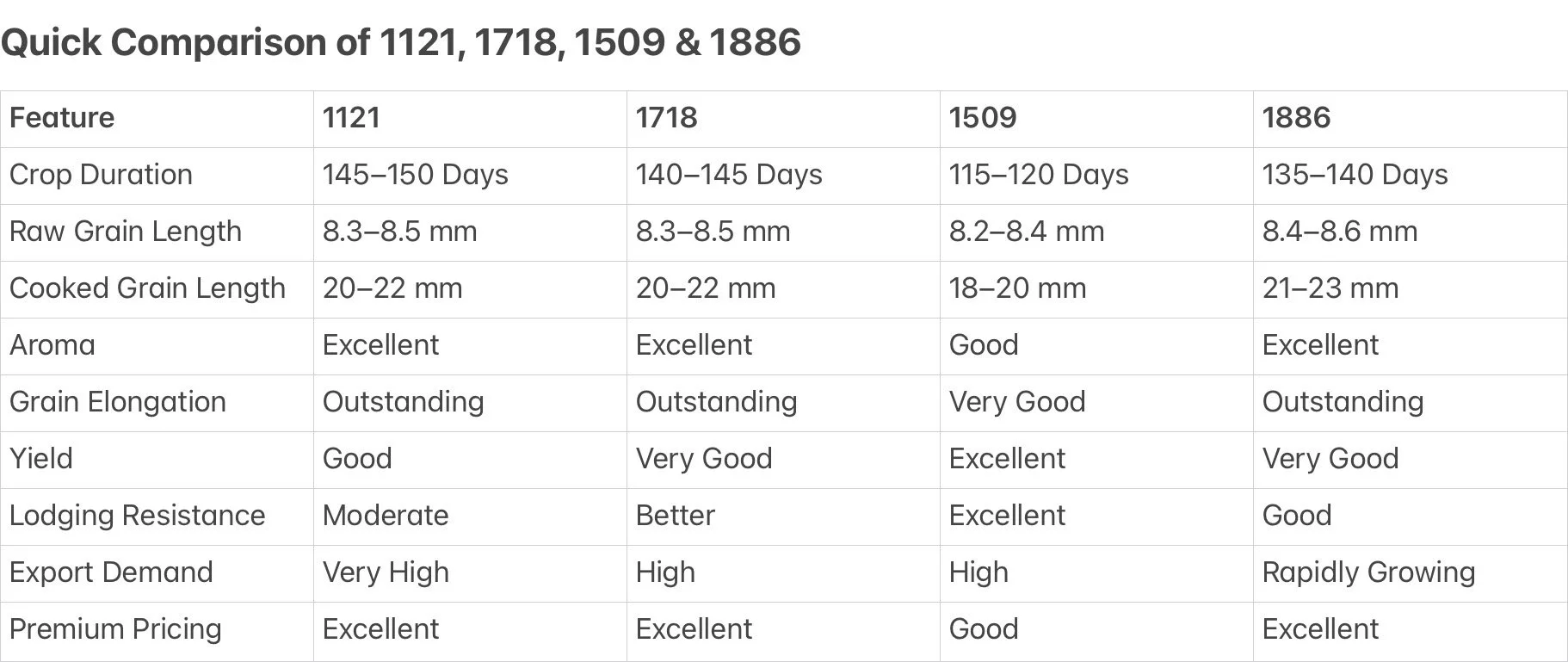
Comparison of Basmati Rice : 1121/1718/1509/1886
This comparison highlights that each variety excels in different areas. While 1121 and 1886 dominate the premium export segment, 1509 offers exceptional value for farmers due to its early maturity and high productivity. Meanwhile, 1718 provides a balanced combination of quality, yield, and field performance, making it a reliable choice for commercial cultivation and export.
Discover the unique characteristics of India’s most sought-after Basmati rice varieties in this comprehensive rice comparison guide from Anantaa Aahaar. In the following sections, we explore each variety in detail, covering cultivation practices, grain length, aroma, cooking performance, milling efficiency, export demand, shelf life, and suitability for different cuisines and commercial applications.
Our in-depth comparison includes the premium 1121 Basmati Rice, 1718 Basmati Rice, 1509 Basmati Rice, and 1886 Basmati Rice, helping importers, exporters, wholesalers, retailers, food service professionals, and consumers understand the strengths of each variety. You’ll also learn about their ideal culinary uses, key international export markets, farmer economics, milling yields, quality parameters, and market trends.
Whether you’re sourcing rice for retail, hospitality, food manufacturing, or international trade, this guide will help you choose the right Indian Basmati Rice based on quality, aroma, texture, yield, and value. The article concludes with expert buying tips, frequently asked questions, and practical insights to simplify your purchasing decisions while showcasing why Anantaa Aahaar is a trusted supplier and exporter of premium Indian rice worldwide
